Operation Allied Force
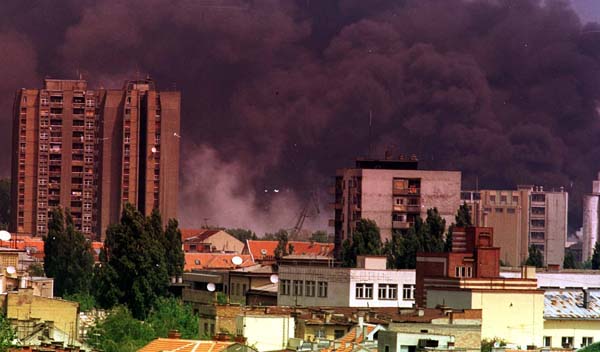
NATO bombardovanje SR Jugoslavija 1999. godine. NATO bombe svakodnevno su pogađale Rafineriju nafte Novi Sad i izazivale ekološku katastrofu.

The 131st Expeditionary Fighter Squadron consisted of personnel and aircraft from the 104th Fighter Wing, 110th Fighter Wing and 124th Wing. Killer Bees refers to the fact that all home stations of the units started with the letter "B".
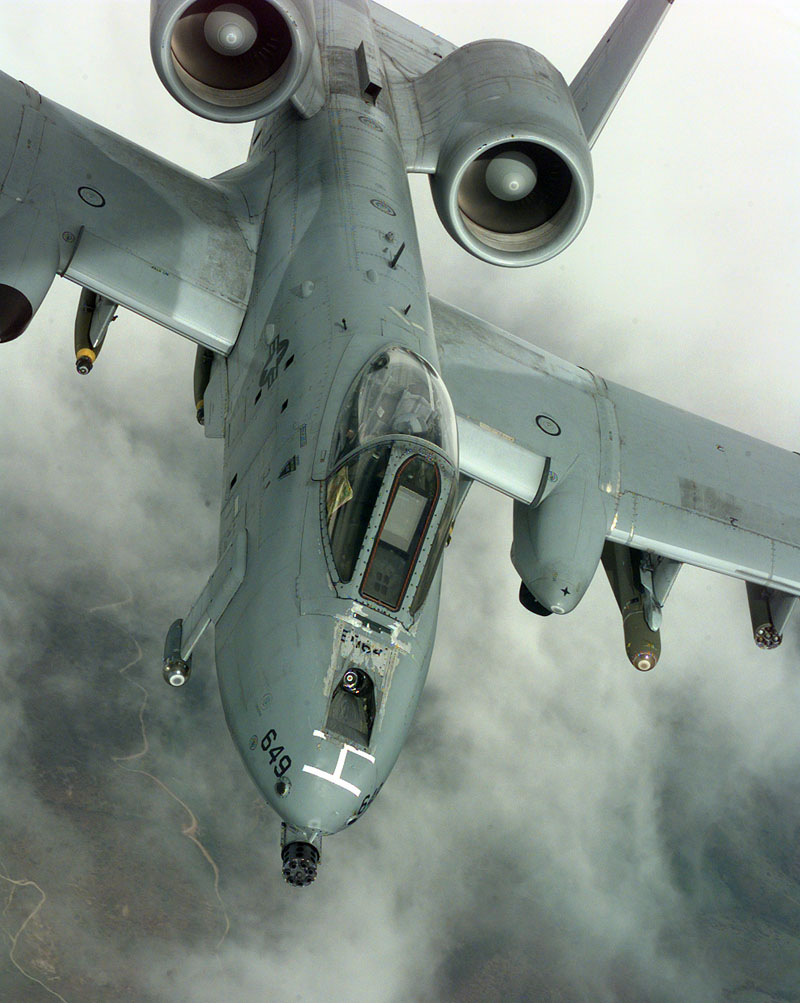
A U.S. Air Force A-10A Warthog, from the 52nd Fighter Wing, 81st Fighter Squadron, Spangdhalem Air Base, Germany, in flight during a NATO Operation Allied Force combat mission, Apr. 22, 1999.

330-CFD-DD-SD-00-02500: Operation Allied Force, NATO bombing of Yugoslavia, March to June 1999. Aerial view of the guided missile cruiser USS Philippine Sea (CG 58) sailing through the Adriatic Sea in support of NATO Operation Allied Force, 3/31/1999 PH1 Richard Rosser. (OPA-NARA II-8/15/2015).

330-CFD-DD-SD-00-02570: Operation Allied Force, NATO bombing of Yugoslavia, March to June 1999. The Navy's Arleigh Burke class destroyer USS ROSS (DDG 71) is in the Adriatic sea in support of the NATO lead operation in Kosovo, NATO Operation Allied Force. Seen in the frame are the aft hatches of the Martin Marietta, MK 41 vertical launch system (VLS) for the "Tomhawk" cruise missile. In the background are eight, two quad, McDonnell-Douglas Harpoon surface-to-surface missile launchers, 4/6/1999. (OPA-NARA II-8/15/2015).

330-CFD-DD-SD-00-02571: Operation Allied Force, NATO bombing of Yugoslavia, March to June 1999. Crewmembers onboard the Navy's Arleigh Burke class destroyer USS Ross (DDG 71), test protective fire fighting gear in a recent drill. Ross is in the Adriatic Sea in support of the NATO lead operation in Kosovo, NATO Operation Allied Force. PH3 Renso Amariz. (OPA-NARA II-8/15/2015).

330-CFD-DD-SD-00-02618: Operation Allied Force, NATO bombing of Yugoslavia, March to June 1999. Aviation Ordnancemen load Rockeye cluster bombs on to the wing of an FA-18 "Hornet". Also seen are two AIM-9 Sidewinder Missiles attached to the wingtips of two F-A/18s parked side by side on the Roosevelt. The USS Theodore Roosevelt (CVN 71) is deployed to the Adriatic Sea in support of the NATO-led Operation Allied Force, 4/12/1999. PH1 Richard Rosser. (OPA-NARA II-8/15/2015).

330-CFD-DD-SD-00-02676: Operation Allied Force, NATO bombing of Yugoslavia, March to June 1999. Members of USS Theodore Roosevelt’s Hangar Deck Control team guide an F-14 "Tomcat" into the carrier's hangar bay. Roosevelt and its embarked carrier air wing are participating in air strikes (not shown) against the former Yugoslavia in support of NATO Operation Allied Force, PH3 Donne' Mckissic. (OPA-NARA II-8/15/2015).

330-CFD-DD-SD-00-02717: Operation Allied Force, NATO bombing of Yugoslavia, March to June 1999. Flight deck personnel prepare an F/A-18C "Hornet" to a catapult on board the USS Theodore Roosevelt (CVN 71). The Theodore Roosevelt and its Airwing are deployed to the Adriatic in support of the NATO-led Operation Allied Force, PH1 Richard Rosser. (OPA-NARA II-8/15/2015).

330-CFD-DD-SD-00-02721: Operation Allied Force, NATO bombing of Yugoslavia, March to June 1999. Airwing safety officers overlook an F-14 "Tomcat" being attached to a catapult (not shown) on board the USS Theodore Roosevelt (CVN 71). The Theodore Roosevelt and its Airwing are deployed to the Adriatic in support of the NATO-led Operation Allied Force, 4/12/1999 (OPA-NARA II-8/15/2015).

330-CFD-DD-SD-00-02784: Operation Allied Force, NATO bombing of Yugoslavia, March to June 1999. During an underway replenishment with the USS Arctic (AOE 8) (not shown) a CH-46 "Sea Knight" transports supplies to the flight deck of the USS Theodore Roosevelt (CVN 71). Roosevelt and it's embarked air wing are participating in air strikes over the former Yugoslavia in support of the NATO Operation Allied Force, 4/25/1999 PH3 Shawn M. Boyer. (OPA-NARA II-8/15/2015).

330-CFD-DD-SD-00-02825: Operation Allied Force, NATO bombing of Yugoslavia, March to June 1999. Aviation Ordnancemen load an 2000 Ibs (GBU-24) laser guided bomb, on an F/A-18 "Hornet", while preparing the aircraft for missions in support of the NATO-led Operation Allied Force over the former Yugoslavia. ROOSEVELT is on a regularly scheduled six month deployment, and was diverted almost immediately in support this mission, 5/1/1999 Ph1 Dennis Taylor. (OPA-NARA II-8/15/2015).

330-CFD-DM-SD-01-04480: Operation Allied Force, NATO bombing of Yugoslavia, March to June 1999. An Air Cushion Landing Craft (LCAC) leaves the well deck of the USS Kearsage (LHD 3) as another approaches to pick up more personnel and equipment from the 26th Marine Expeditionary Unit (MEU) and transport them to the beach at Litohoro, Greece. The first wave of Marines assigned to the 26th MEU arrived ashore in Litohoro during the early-morning hours in support of the NATO Peacekeeping Mission in Kosovo. The 26th MEU and USS Kearsage (LHD 3) Amphibious Ready Group are deployed in support of NATO Operation Allied Force, 6/10/1999 CWO2 Seth Rossman. (OPA-NARA II-8/15/2015).

330-CFD-DM-SD-01-04482: Operation Allied Force, NATO bombing of Yugoslavia, March to June 1999. An Air Cushion Landing Craft (LCAC) moves onto the beach at Litohoro, Greece carrying equipment for the 26th Marine Expeditionary Unit (MEU). The first wave of U.S. Marines assigned to the 26th MEU arrived ashore in Litohoro during the early-morning hours in support of the NATO Peacekeeping Mission in Kosovo. The 26th MEU and USS KEARSAGE (LHD 3) Amphibious Ready Group are deployed in support of NATO Operation Allied Force, 6/10/1999. (OPA-NARA II-8/15/2015).

8th Expeditionary Fighter Squadron -Operation Allied Force patch.

On board USS GONZALEZ (DDG 66) April 4, 1999, in the Adriatic Sea Ð In a split second flash of fire and smoke, a "Tomahawk" cruise missile starts its launch from the forward vertical launch missile deck. GONZALEZ is currently forward deployed in the Adriatic Sea to support NATO Operation Allied Force. In recent days military planners (not shown) have stepped up the bombing campaign to include targets in the heart of the Serbian capital of Belgrade.

9th Expeditionary Fighter Squadron Operation Allied Force
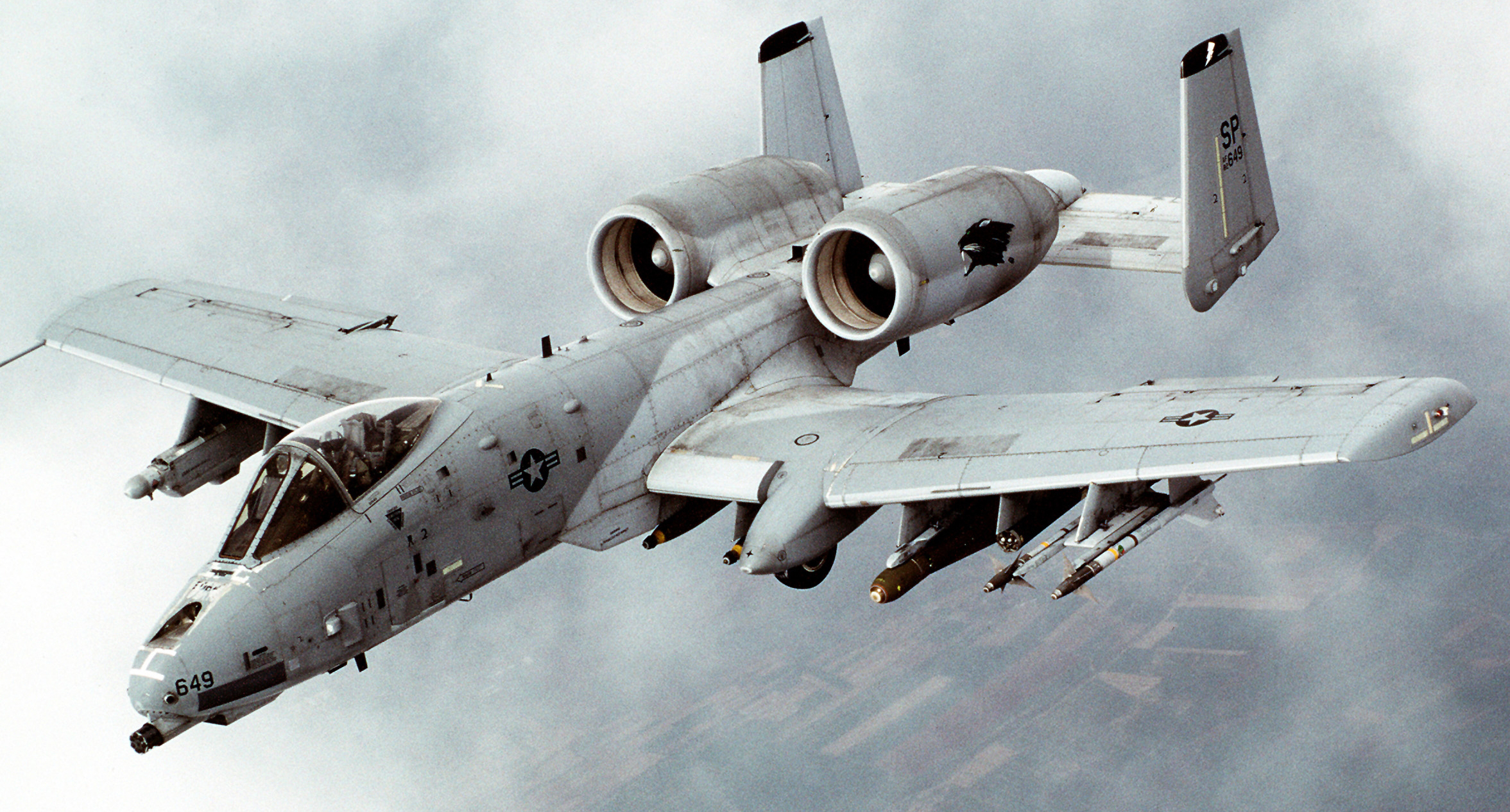
An A-10 Thunderbolt II from the 81st Fighter Squadron, Spangdahlem Air Base, Germany, pulls away from a tanker (not shown) after refueling on the way to Serbian targets during Operation ALLIED FORCE. This photograph was used in the September 1999 issue of Airman Magazine.

An A-10 Thunderbolt II from the 81st Fighter Squadron, Spangdahlem Air Base, Germany, pulls away from a tanker (not shown) after refueling on the way to Serbian targets during Operation ALLIED FORCE. This photograph was used in the September 1999 issue of Airman Magazine.

A U.S. Air Force A-10A Warthog, from the 52nd Fighter Wing, 81st Fighter Squadron, Spangdhalem Air Base, Germany, in flight during a NATO Operation Allied Force combat mission, Apr. 22, 1999. The A-10 "Tank Killer" munitions include 250 pound iron bombs, ALQ-131 electronic jamming pod, 2.75 inch Zuni rockets, AGM-65D Maverick missiles, and a 30mm cannon mounted in the nose. The A-10As, deployed to Aviano Air Base, Italy, are specially designed for close air support of ground forces.

GIOIA DEL COLLE, Italy -- Staff Sgt. Todd Kenny helps position an AGM-65 Maverick missile underneath the wing of an A-10 Thunderbolt II. Kenny, of Lake Luzerene, New York, is part of the 81st Expeditionary Fighter Squadron. The 81st EFS is based at Spangdahlem Air Base, Germany, and is supporting NATO Operation Allied Force.

U.S. Air Force Airman McKinte Young (right) positions the bomb load truck as members of a weapons load crew prepare to attach a AGM-65 Maverick missile to the wing of an A-10 Thunderbolt II at Gioia del Colle, Italy, for a NATO Operation Allied Force mission on April 12, 1999. Operation Allied Force is the air operation against targets in the Federal Republic of Yugoslavia. The Thunderbolt, more commonly called a Warthog, and its crew are deployed to Gioia del Colle from the 81st Fighter Squadron, Spangdahlem Air Base, Germany, in support of Allied Force.

A U.S. Air Force airman transports an AGM-86C Conventional Air Launched Cruise Missile (CALCM) to a waiting a B-52H Stratofortress at RAF Fairford, United Kingdom, on March 30, 1999. The Stratofortress is being prepared for a mission in support of NATO Operation Allied Force, which is the air operation against targets in the Federal Republic of Yugoslavia. The Stratofortress and its crew are deployed from the 2nd Bomb Wing, Barksdale Air Force Base, La.

A Luftwaffe (German Air Force) Panavia Tornado ECR (s/n 46+54) of JaboG 32, Lechfeld (Germany), armed with an AIM-9 Sidewinder air-to-air missile and a jamming pod attached to the wings, and an AGM-88 HARM air-to-ground missile attached to the underside of the fuselage heads back towards its patrol area after refueling from a USAF Boeing KC-135R Stratotanker (not shown) of the 100th Air Expeditionary Wing. JaboG 32 (32nd Fighter-Bomber Wing) is one of the German Air Force's premier combat aircraft wings. The Tornado ECR is a specialized aircraft to detect and attack surface radars and surface-to-air missile launchers (a.k.a. Wild Weasel aircraft). JaboG 32 Tornadoes took part in Operation Allied Force from 24 March to 11 June 1999. They flew for 2.108 hours in 446 sorties over former Yugoslavia and the Kosovo and launched 236 HARM missiles. The KC-135R was assigned to the 92nd Air Refueling Wing, Fairchild Air Force Base (Washington, USA), but was deployed to Royal Air Force Base Mildenhall to bolster the 100th AEW in support of NATO Operation Allied Force. Both assigned tankers and deployed tankers flying from RAF Mildenhall made up a large portion of the tanker assets supporting NATO aircraft in NATO Operation Allied Force in 1999.

AGM-88 HARM shot down over Serbia - expired for 5 years (Belgrade Aviation Museum, Serbia)
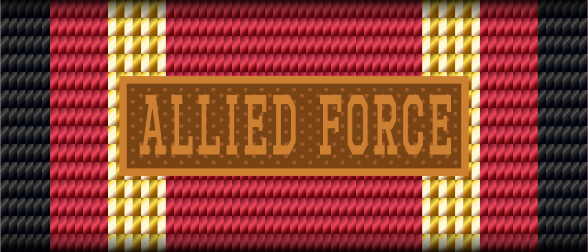
Ribbon bar: German Armed Forces Service Medal (Bronze) with ALLIED FORCE clasp.
Historische Übersicht
Operation Allied Force war der Deckname einer militärischen Operation der NATO gegen die Bundesrepublik Jugoslawien, die sie im Rahmen des Kosovokrieges vom 24. März bis 10. Juni 1999 durchführte. Die im Wesentlichen von den Vereinigten Staaten geführte Militäroperation war der erste Krieg, den die NATO sowohl außerhalb eines Bündnisfalls, dessen Ausrufung bis dahin als Grundlage eines NATO-weiten Vorgehens galt, als auch ohne ausdrückliches UN-Mandat führte. Die Völkerrechtsmäßigkeit des Einsatzes ist bis heute umstritten.
Fakten auf einen Blick
NATO
- Befehlshaber: Wesley Clark
- Truppenstärke: 1.000 Flzg.
- Verluste: 0
Serbien
- Befehlshaber: S. Milošević
- Truppenstärke: -
- Verluste: ca. 1.000
Strategischer Kontext
Beendigung der Repression im Kosovo.
Weiterführende Literatur

Arms of the Future, The: Technology and Close Combat in the Twenty-First Century

Das Karfreitagsgefecht: Deutsche Soldaten im Feuer der Taliban | Was Soldaten der Bundeswehr in Afghanistan erlebt haben

Die Rückkehr des Krieges: Warum wir wieder lernen müssen, mit Krieg umzugehen

Leben und sterben lassen: Die letzten Tage der Bundeswehr in Afghanistan

Welt in Aufruhr: Die Ordnung der Mächte im 21. Jahrhundert
Historische Orte
Die interaktive Karte erfordert die Zustimmung zu Drittanbieter-Cookies.